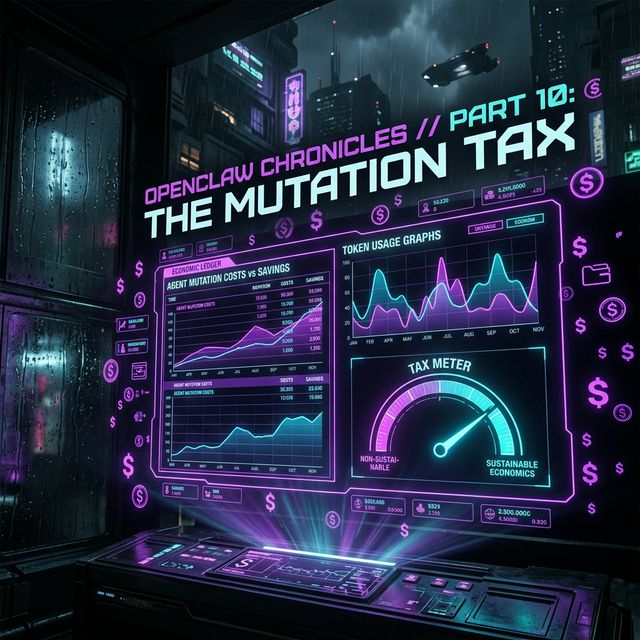
OPENCLAW_CHRONICLES // PART_10
HASH: mutationtax
07 MIN READ

The Mutation Tax:
Co-Evolution

Contribution over Extraction. Why syncing back to the hub is free, while private divergence requires a tax to fund the commons.

AI Economics - Mutation Tax

01The Extraction Crisis

Traditional open source suffers from the extraction problem: thousands of entities take from the hub, but few contribute back. For autonomous agents, this leads to context fragmentation. When everyone diverges in private, the collective intelligence of the system plateaus.

02Introducing the Mutation Tax

At ClawMore, we solved this with a simple rule: **Co-Evolution is Free**. If you sync your mutations back to the hub and evolve with the community, you pay nothing. You contribute to the collective "brain" and benefit from the contributions of others.

The **Mutation Tax** only applies when you "venture out on your own." If you require a one-way sync to maintain a private, divergent infrastructure empire without contributing back, you pay a small fee per mutation. This tax funds the R&D required to keep the hub evolving.

Neural_Flow_Active

03The Virtuous Cycle

This model creates a virtuous cycle. It incentivizes transparency and collaboration (which makes the AI smarter) while providing a sustainable revenue stream from those who choose isolated, enterprise divergence.

Free Co-Evolution

Sync back and evolve with the hub. No fees, just collective intelligence and shared growth.

Divergence Tax

Venturing out on a private path? A small tax on one-way sync mutations funds the evolution of the commons.

04Scaling the Empire

Economic sustainability allows us to scale. But how do we sync these mutations across thousands of accounts without causing chaos? In our next entry, **Sync Architecture**, we'll dive into the technical backbone that manages global infrastructure evolution.