In the final installment of the OpenClaw Chronicles, we’re moving beyond the technical architecture to address the ultimate question: What is an agentic repository actually worth?
Software engineering has always struggled with measurement. We use Story Points (complexity) or Hours (effort), but we rarely measure Evolution Velocity—the speed at which a codebase improves itself autonomously.
The Complexity-to-Value Bridge
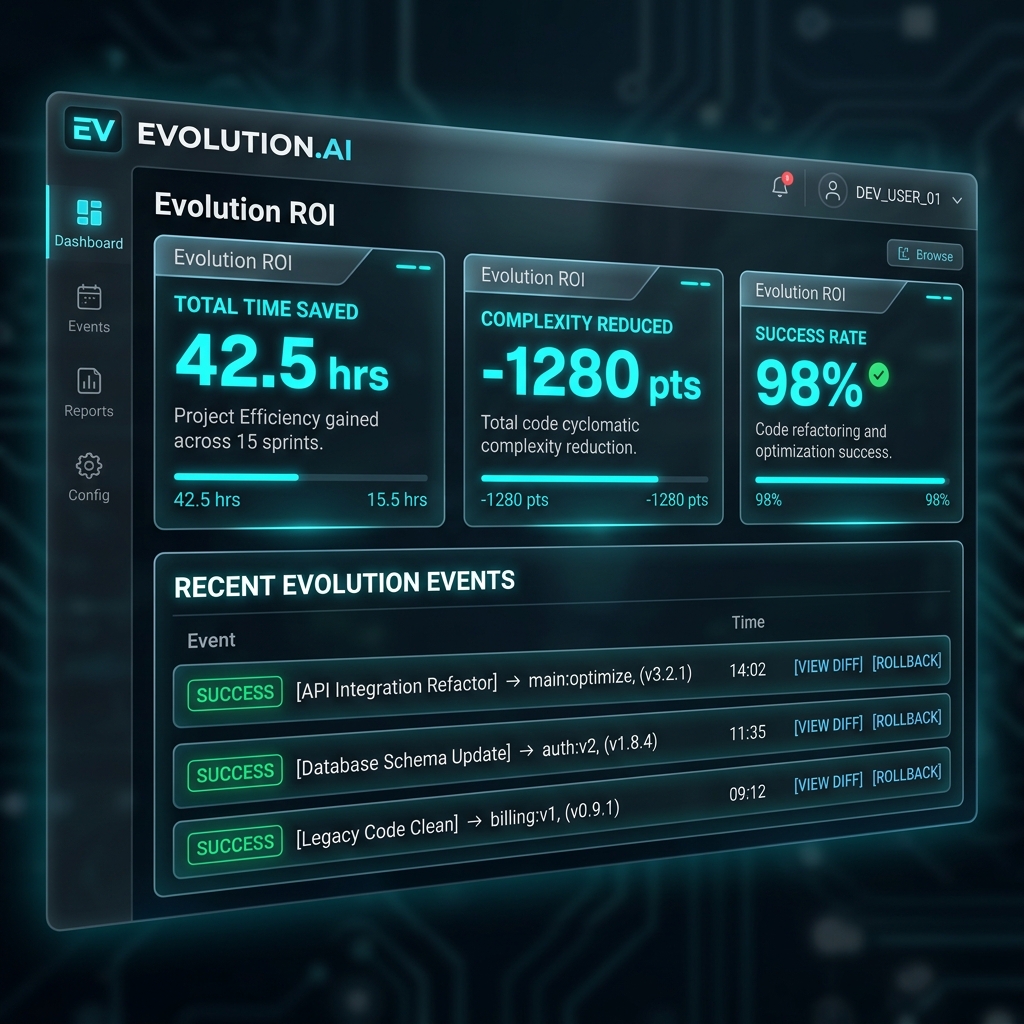
Earlier in this series, we defined the "Agentic Wall" (Post 1) and the "Neural Spine" (Post 3). We built the infrastructure to let agents mutate the code safely. Today, we’re unveiling the Evolution ROI Dashboard—system-level tracking for autonomous software gains.
1. Quantifying the "Navigation Tax"
Every developer knows the pain of navigating a fragmented codebase. In a Living Repository, agents handle the navigation tax. We measure this through a new metric: Time Saved. Using a conservative $120/hr developer baseline, we track the minutes saved on every successful agentic refactor.
2. Entropy Mitigation Index
Technical debt is just entropy of the mind. Our agents don't just "fix bugs"; they reduce complexity scores in real-time. The dashboard tracks total points of Cyclomatic Complexity removed from the system.
Total Time Saved
42.5hrs
Per release cycle
Complexity Reduced
-1280pts
Decoupled logic points
3. The Mutation Tax is a Dividend
We’ve reframed the "Mutation Tax" (metered billing for agent actions) not as a cost, but as an Investment Dividend. Spend $5 in credits to save 3 human hours. The math is undeniable.
FINALE // ASYNC_SUCCESS
This concludes our 13-part series on the Agentic Readiness Shift. We’ve built the metrics, the architecture, and the proofs. The Living Repository is no longer a dream; it’s a dashboard full of green bars.